Big Block Production - 1961 to 1972
Big Block Crosleys
The term big block Crosley is starting to be used as some of these late boat engines are converted in to car engines and put into Crosleys. Normally they are referring to the 59 cu. in. blocks. The 53 cu. in. Crofton also qualifies but very few have shown up. The big blocks have a 2.75" bore instead of the normal 2.5". To get this larger bore the block casting was modified, forging the cylinders together to get more wall thickness, without changing the crankcase mounts and normal geometry of the engine. The stroke was increased to get the other 6 cubic inches to make 59 CI.A quick way to tell if you have a big block engine is to look at how the block mounts to the crankcase. If the block is held to the crankcase by nuts it is a small bore, on the large bores there isn't room for nuts, studs screw into the block from below.

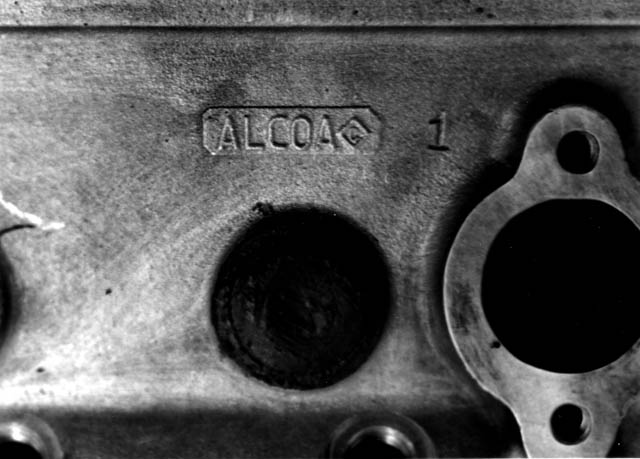
These are the larger displacement style. The History we have
collected indicates that Fisher Pierce contracted with ALCOA to build
10 blocks in the hope of making a lighter version of the Bearcat
55. Only 6 blocks were delivered because of casting problems that
would have required completely new molds to be made. At least
some of the 6 blocks were built in to test engines, all leaked because
of seeping through to the crankcase because of the porosity of the
Aluminum. In the end they abandon the project because the weight saving
didn't justify the cost. It is believed all 6 made it out of the scrap
bin, at least 2 have surfaced.

An Early Homelite, the boat parts were traded off before I got
it.

Homelite
Homelite, a division of Textron Inc. in Port Chester NY, in 1961 took over the ownership of the Crosley family tree and developed a successful derivative. They increased the displacement to 59 CI, enabling a rated 55-HP at 5500 RPM. The 59 CI was obtained by increasing the 53 CI Fageol/Crofton's 2.25 inch stroke to to 2.5 keeping the 2.75 inch bore.
More info on Homelite
Page.
This is a partial archive left from when Members AOL hosting went
away. If you find it's new home let me know.
It appears only the Homelite "A" blocks have hardened valve seats. All Bearcats have hardened seats.

Mid production changes.

Late Production, stock engine is white.
The Homelite and Bearcat models blend from one to the other. Here is some information from a collector Bruce Gerard, on the differences he has found and how to tell what vintage engine you have.
The early Homelite blocks did not have hard valve seats. All Bearcats had hard seats.
On the early Homelite block, there is usually no large embossed letter appearing below the block number. Also, at the tower shaft end of the block, you will find the standard boss tabs for the original Crosley fan mounting. There will be no lower mounting boss.
Starting in the mid Sixties Homelite changed the block to include hardened valve seats. Looking at the block number, you will see a large embossed letter below the block number. The first series was indicated with large "A" (this is known as an "A" block.)
Another important change was the addition of a second mounting boss on the tower shaft end of the block. The second mount boss was placed at the base of the tower shaft housing. This mounting boss was added to allow 50% stronger mounting of the block to the outboard base plate. The upper mounting boss was retained, so these blocks have two mounting bosses on the tower shaft housing.
The Bearcat blocks are marked with a letter "F" (F block) & I believe this was the last style made. I don't know of any changes to the block, but the alloy may have been modified somewhat, in an attempt to make it more resistant to corrosion.
There may well be other block styles between these two, but I don't have any info on that at this time.
Another place to date a Homelite is to look at the crankcase. The early Homelite had the oil filler cap mounted to the oil pan. On these motors, there are no side holes in the crankcase casting.
In the mid sixties (1964?) Homelite moved the oil filler cap to the side of the crankcase casting (manifold side of block) These have a large threaded hole right through the side of the crankcase.
When Fisher Pierce took over building of the motor, there was period of transition where Homelite & Bearcat parts appeared on the same motor. That makes doing an ID of a motor much harder.

Bearcat 55
Fisher Pierce, of Boston Whaler fame, re-badged the Homelite
engine as the Bearcat-55 in the early production. The Bearcat was
produced for six years, from 1966 until 1972. By the time the engine
production ended many refinements had been made to improve the design. Bearcat Ad.
More info on Boston Whaler Page.

The Bearcat block usually has a large "F" embossed below the casting numbers. Here are a carb and starter side view.

From Bearcat 55 Flyer
The Homelite/Bearcat variant drives off the front of the crank with the flywheel up.

The End?
Bearcat is the end, as far as I know, to the Crosley extended
engine family. Several dedicated Bearcat fans continue to rebuild,
refine and sell the boat engines but none have started remanufacturing
as far as I have been able to find out.
Any correction or additions are welcome.
Taylor
Years
CoBra Years
CIBA Years
Post Crosley
Big Block Years
| Taylor Years | CoBra Years |
CIBA Years |
Post Crosley | Big Block Years |


