Cranks
Note: Lots of controversy and difference of opinion on naming of the different cranks, so rather than changing the terminology everyone has used for years, I am adding Barry Seel's explantion. So read the following messages with what Barry has explained in mind.
NOT CAST STEEL!!! DROP FORGED STEEL. Much better. Cast steel cranks are also called nodular iron. All engines after Motoe Number 96,000 have nodular iron cranks. Many military engines are Motor Number 120,000 and above, and have a "C" stamped after the number. These engines have forged steel cranks. I have found a lot of Aerojet military engines that had 6 bolt holes in the flange, had the "C" stamped in the serial number and had nodular iron cranks. I believe Aerojet was pulling a fast one on the government to save money. All the contracts for military engines specified forged crankshafts. The start of Commercial engines start around 105,000. - Barry
Note: I believe the cranks with the tapered nose at the spline are what Barry calls Drop Forged Steel, best of fairly easy to find. The cranks used in engines built as Cast Iron Block engines and not just converted had mostly Nodular Iron Cranks, fine for normal driving. All engines that were sold as tin block engines originally had the weaker cast iron crank, treat very gentily.
Durability
viper1941 2/23/00
Y class Crosley powered
boat...my dad broke 100mph in that boat. My dad wouldn't put a wild cam in it for
me but he did other things to it. a 2bbl carb, tuned exhaust,no
muffler,wico mag, and a balanced steel crank. It would turn
upwards of 6000rpm when stock Crosleys came apart at 4500 or
so(due in part to weak cast iron cranks and cast iron pressure
plates and springs coming apart). He fitted an international
harvester tractor clutch with a reduced diameter flywheel and bell
housing which mean't I could really smoke the tires...I remember a
buddy of mine had a 47 ford flathead that couldn' catch me in a
drag...That was saying something as the transmission was,as you
all know, a crashbox. I became very good at double
clutching...OOPS! I babble.....This club and seeing all the photos
sure does bring on waves of memories... Later... Viper
Jim_Bollman 2/27/00
Viper, Just wanted to clear up your statement about
Crosley engines coming a part at 4500 RPM. I agree the cast iron
cranks were prone to breaking I have a few broken ones myself. In
general they hold up pretty well, I would not be afraid to run a
stock engine up to 5000-6000 RPM from time to time going through
the gears. With only the addition of a cast steel crank I would do
it on a regular bases without much concern. I regularly run my
Crosley at 55 mph which is over 5000 RPM. Through experimentation
I have found that the stock valve train floats at around 7800 RPM
(not recommended). Jim...
viper1941 2/28/00
Jim...There were 3 cranks manufactured for Crosley
engines. Two by Crosley and one after market for performance
applications...The two by Crosley were a cast iron crank and a
(spelling may be wrong..naugular cast iron.) This was a slightly
hardened version of the original...Trust me, if you had a cast
iron crank, you didn't routinely rev much over 45-4800 very
often...That crank was replaced as the original very early in the
development of the engine...You didn't find many in the cast iron
block engines after 1949(dates are foggy)...The hardened crank
could take revs in the 5-6000 range without problems... The third
was a forged steel crank that NEVER came apart...valve float, the
weak point was the little keepers, one had to use hardened ones to
keep valves from becoming pistons above 7000 revs
routinely...also, the springs could be replaced with those from
another make engine(the name escapes me at the moment...in
addition the springs from the military application
engines(aircraft) had extra firm springs (and as a info note the
blocks had two s and gear driven mags off the cam at the front of
the block.) The army(b4 airforce,) spent a lot of money trying to
develop the engine to military aviation use, but abandoned the
effort before the cast iron block was fully developed. Yes there
were 2 plug tin blocks around. Viper
chuckhk1941 2/28/00
In pulling engines apart I've found 3 versions of the
cast crank--2 with the counter weights ground for balancing-both
with different front splines. One requires a spacer behind the
gear,one does not!!the third has the counter weights drilled,not
ground. All have the same part #. NONE ARE STEEL --so we have
more confusion?
viper1941 2/29/00
Confused? You won't be after this episode(to paraphrase
the series Soap)...The steel crank was not a Crosley factory item.
It was strictly a performance part obtained thru racing and high
performance parts suppliers...The best crank from the factory was
the nagular iron(spelling?) crank. Probably one of the two types
that you have found was one of them...I do not remember how to
tell them apart...but hitting them with a tuning fork seems to
come to mind, but I'm not sure what to listen for if that is
it...Probably some marking on them of some kind...I'll ponder it
for a bit and maybe I can be of better help.(Damn...I really hate
it when CRS kicks in) Still confused? Tune in tomorrow. LOL. Viper
trainnut2 2/29/00
There were 3 types of cast cranks made while Crosley was
in production. There was also a nodular iron crank, also called a
cast steel crank, and a steel billet crank. There was also a
company in Italy that made steel billet cranks, and other high
performance parts for the Crosley racers. I totally agree with
Jim, about the cast cranks being able to take high revs. I used to
use Crosleys for go-karts when I was a kid, and we abused those
cars badly. The valves would float, and protect the crank from
breaking. It wasn't till we started to shave the bottom of the
cylinder assy to get more compression that we started to blow them
apart, and when they blow there's no salvaging any parts! I just
recently tore down my 49 Crosley wagon that I used as a kid and
found that the crank was a nodular iron one, and still could be
used, and I beat that poor car badly!
Jim_Bollman 2/29/00
Well if we keep talking about cranks long enough we may
solve this problem. Part of the problem is knowing if we are
talking about the same type cranks or not. I believe there were at
least 3 cranks made by Crosley in post war production. I think
there was a poor cast iron in the early production years, this is
also when a large number of the engines were made so a lot of
these cranks were around. I think the next cast iron crank is the
one I said was OK and could take a fair amount of abuse. In the
military engines and in the late production years (1951-52) they
used what I call a cast steel crank. This crank has a nicer ring
if you tap it and has a tapered nose to add strength to the
splined part of the crank, the rest doesn't look much different
than what I call cast iron. I have never seen one of these cranks
broke and try to use these in all the engines that I build or use.
I have also seen the racing cranks people have talked about that
look like they were machined out of a solid piece of steel. A lot
of cranks are broke at the front bearing because of a bad gear
adjustments for the tower/distributor gears. I bought a Super
Sports, years ago, after test driving it and noticed a small tick
in the engine. When I tore down the engine, expecting a bearing
problem, I took the crank out in two pieces broke diagonally
across a counter balance.
speedoo51 3/1/00
I'll add a few cents more...I think some cast steel
cranks needed a spacer between the front bearing and the dist/oil
pump drive gear. Cast iron ones, the gear was shouldered on the
splines. I think I read that Nick [Braje] said that
industrial engines [at least some] used a Forged steel
crank. The company in Italy was Nardi, And Webber in the U.S.. The
webber was either a stroker [with overbore near 60 cu.
in.] or available in stock also. I find the aero engine
fascinating, is information-pictures available? I used to get over
30 mph in first, if you figure the overall gear ratio, it comes
out at around 9000 rpm. I think I shimmed the valve springs but I
got some CRS too....I didn't do it often but when I did the engine
developed a very loud clanging noise, but still would run 30. Oil
pressure was ok so I figured it must have hammered a wrist pin
bushing out. I think back now, what a scary kid I must have been!
No fear, no brains; I pick the latter!!!!
Crank Pictures & Latest Theory
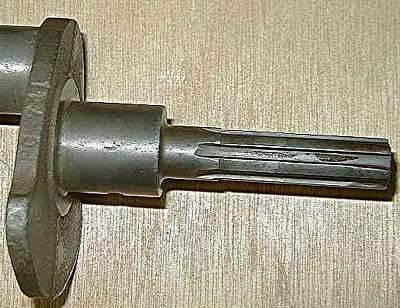
Jim_Bollman 3/5/00
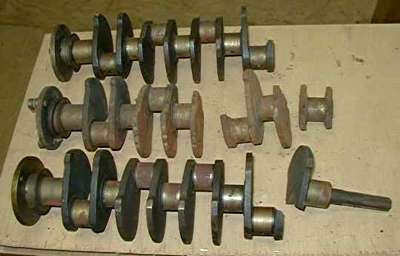
I spent Saturday morning doing a study of all the cranks
I have, that were out of engines. After much scrounging and
digging around in my junk I found 10 cranks, without dropping any
oil pan. I have posted pictures to help us start talking the same
language on cranks. See Below. Feel free to send pictures of
different cranks that you may have. Things I learned: Of the 10
cranks, 8 were the same style including 3 broken ones. They are
stamped PC-741 on the first counter balance. I think this is the
early, probably through 48 or 49, crank. This is when they made
the most engines and therefore probably the most survived. The
only crank out of 10 with a drilled counter balance was one of the
broken ones. Anyone else keep any broken cranks? Would you check
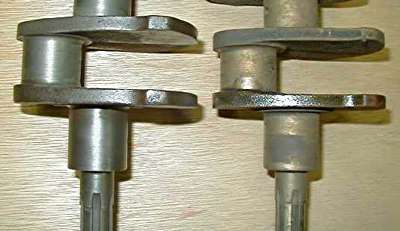
to see if they are this style or not? The other two cranks have
thinner throws. If you measure the thickness of the counter weight
with a caliper along the edge on the side of the counter, the
PC-741's are roughly .35 inches the later are about .30 inches.
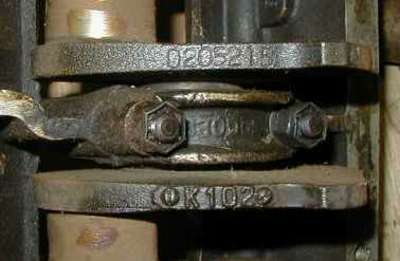
The two later cranks have D205215 stamped in one of the center
counters. Since I only have two of these and they are slightly
different more input would be good on this style cranks. One of
these later cranks has a squared off nose where the bearing drops
down to the spline just like the early cranks. It has the D205215
stamped on the 6th counter weight from the front. It has a tag
that looks like it is screwed on (it was a tag on the master that
was used to make the molds) with B151 on the 5th counter. I don't
know if this is a unique number or not. Anyone have any cranks
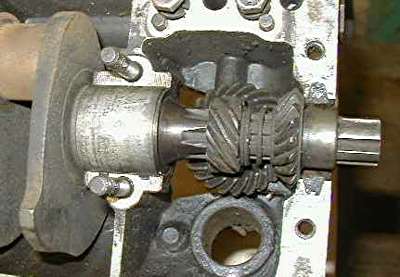
like this one? The other late style crank is what I always call a
Cast Steel. What do you call it? It has a tapered nose where the
bearing drops down to the spline. It has D205215 stamped on the
5th counter weight from the front. The tag that looks screwed on
is on the 4th counter weight and is K102. This last crank is the
style I have in several of my engines that are in cars and is
known to be a tough crank. One last observation, the 2 military
generator engines I have, have 6 threaded holes on the flywheel
flange, all the cranks I have out of engines only have 3. The
picture of the broken cranks includes a crank that was in a
running engine, I actually drove the car before buying it. It had
a slight tick that I thought was a bearing. This was before I had
very many spare parts and no extra cranks. I was not happy when I
tore the engine down. Ok that was my Saturday morning, look at
your cranks and see if we can add to this information. Jim...
silkytwo_99 3/6/00
I have a info sheet put out by James Broadwell. He ran
hot class H Crosley specials back in the late 50's or early 60's.
To quote from his sheet: Crankshaft: Most Crosley engines as found
have cast iron cranks. These are not usable. Later model engines
have either cast steel or forged cranks which are usable. The
forged steel cranks are identifiable by the fact that the throws
are machined on both sides and the outer diameter. Both cast iron
and cast steel cranks show the casting marks on the throws and can
only be identified from each other by "sparking". This consists of
holding a portion of the throw against a grindstone and observing
the color of the sparks, dull red for cast iron and white sparks
which have a tendency to break up, for the cast steel. If you use
a forged shaft, I strongly recommend the use of "white" bearings
which were those having a silver-like color (McQuay-Norris). If
you sue the cast steel, then I would recommend the bronze color
bearings (Federal Mogul). This is old information but maybe it is
still good today.
viper1941 3/8/00
Confused?...you won't be after this episode...After
talking with my brother whom being almost 4 years younger than me,
and as he was around the Crosley scene a little longer than me,
and as his memory probably is a little better, here is the
straight scoop (?)....Crosley had only two types of cranks from
the factory...cast iron and (again spelling) naugular iron. Now,
there was one cast iron crank designed first and put in the tin
block engines...then when they found out they were failing due to
harmonic vibration...they tried several fixes...balancing,
lightening them, etc...add that to the fact that more than one
sub-contractor was manufacturing the cranks, no wonder you have
more than one type of cast iron crank...then about the time the
cast block hit the market (give or take)...they introduced the
alloy cast iron crank (naugular) Neither I or my brother can
remember what that stood for except that it was a higher grade
crank with maybe nickel or low grade steel thrown in, but the fact
remained that it was still a cast iron crank...and it probably did
have a nicer ring to it(remember my previous statement about
tuning forks?...The third of course was the forged steel after mkt
crank....so you see?...we are all probably right Who woulda
thought that after 50+ years that the little engine that could,
would still be cussed and discussed...A little trivia...do you
know that an Italian Co., bought the rights to the engine and
tried to develop it further? Was in the late 50's or early 60's. I
don't really know too much about that...my brother threw that in.
speedoo51 3/9/00
Nodular-the higher the content, the stronger the casting.
Cast steel is just that, not have the carbon content of cast iron,
there for softer and not brittle. Will bend more before breaking.
Does not wear as well as cast iron. Must have been at least three
cranks [re:342] as I have several articles written by
those involved with the Crosley engine for some type of racing in
the 50's & 60's that say cast iron, cast steel, and forged. I
believe the forged may have [and probably was] been in
severe duty industrial applications. Did you know that Crofton
advertised a 53 cu. in. version; .125 larger [2.625] bore,
same stroke rated at 35 HP. I have the literature but don't know
if they were actually produced. I'm pretty sure Aerojet-General
continued to produce the engine after procuring Crosley, but if
Crofton, Fageol and others [?] bought the rights and
produced the engines or merely put their names on them or in what
chronological order they were in I'm not sure. Can someone put it
in order?
speedoo51 3/15/00
I had one more thought, many sheet metal engines were
probably changed over to cast iron and so will still have an early
crank. I had several cast iron blocked engines and none had what
is now described as a steel crank. Where is everyone?
What Year for What Crank
phil39_2001 8/15/00
Just found the photos of various cranks used postwar.
What model years were the various types of cranks used? I have a
'49 but never noticed the number on the crank when I had it apart.
Jim_Bollman 8/15/00 10:27 pm
I'm still collecting information. I do know that most
military engines have the cranks with the tapered front (picture
4), the best of the cast cranks. I have also seen this crank in
some late 51-52 engines. When they switched from the original cast
iron to the intermediate style is not clear. My best guess is the
original crank was used in the COBRA tin block engines and when
they redesigned for cast iron block in early 49 they switched to
the intermediate style crank. Remember that a lot of COBRA engines
were converted to cast iron blocks so a cast block doesn't mean a
better crank. Also engines have been swapped around a lot since
the cars were built so the year of the car doesn't mean much about
what engine is in it. The engine Serial number gives you an idea,
but they number consecutively after mid 47 so you can only get a
rough idea. The tapered style cranks I have found in standard
engines all had serial numbers in the 6 digit range. The 1946
engines start with CC46 and early 47s had CE47. Hope this helps.
Maybe other will add their findings.
Elgin
h_mod 8/19/00
Am stripping down an old Elgin outboard. Carbs are twin
Tillotson (?) into a log manifold. Entire exhaust/intake manifold
is water cooled - or warmed, depending how you look at it. Any
idea of dates of manufacture? Crank itself has curved tapered
reduction to nose. Rear of crank has a single nut holding on the
flywheel. This nut is itself toothed, and a connector to drive
shaft is slid onto it. The counterweights have a "cast" look. On
the 2nd CW edge a fake ID plate is cast in saying "A18". On the
other side is a cross with one arm bent followed by "2". On the
1st CW the label "PC872" appears. This may be the so called
nodular iron crank referred to by James Broadwell. The oil pump is
the HD, fatter type. Main bearing webs are also fatter. Elgin may
have been sold by Sears, but I have no idea when. Anybody know?
for365nc 8/20/00
Elgin was definitely sold by Sears. Believe they were
manufactured by West Bend. Check out the
Antique Outboard Motor
Club Inc. I think you'll find answers to a
lot of your questions.
Jim_Bollman 3/03/02
Resent information I have found indicates Fageol built
the Elgin engine for Sears.